
Why Aren't There Apostrophes in Place Names in the US? A Guide to This Quirky Rule

At first glance, it appears there's an apostrophe absurdity in many of the national treasures and popular spots to visit. When you see names like Kings Canyon National Park, Devils Tower, or Angels Landing, they appear to beg for an apostrophe. What your eye doesn't catch, Grammarly surely will.
However, Grammarly is wrong, and a solid explanation backs up why apostrophes are missing from some geographic names but not others.

Why Apostrophes are Missing from Geographic Names
Apostrophes are often missing from many geographic names due to historical and practical reasons. One significant factor is the policies of naming authorities like the United States Board on Geographic Names (BGN), founded in 1890, which has a longstanding rule against using apostrophes in place names.
This rule aims to avoid confusion in map printing and data entry, ensuring consistency and clarity in geographic data systems.
"Although these spellings generally conform to rules of English, they reflect historical spellings or forms commonly used or preferred by local citizens and may, therefore, include what appear to be grammatically incorrect, misspelled, improperly combined, or clipped words." - BGN Geographic Names
For example, "Pikes Peak" in Colorado and "Harpers Ferry" in West Virginia lack apostrophes despite originally being possessive forms (Pike's Peak and Harper's Ferry). The BGN decided to drop apostrophes to simplify names and prevent the possessive form from implying private ownership of a public place.
Additionally, the exclusion of apostrophes helps in digital databases and GPS systems, which might misinterpret or malfunction with the inclusion of special characters. In essence, the absence of apostrophes in geographic names is a blend of tradition, practicality, and the need for uniformity in cartographic and data systems.
The Apostrophe Exceptions
As of now, only five geographic names in the U.S. have been granted permission to use apostrophes, usually after decades of appeals:
Martha’s Vineyard (Massachusetts) – Approved in 1933 after local pushback.
Ike’s Point (New Jersey) – Granted in 1944 for a historical fishing spot.
John E’s Pond (Rhode Island) – Approved in 1963.
Carlos Elmer’s Joshua View (Arizona) – Approved in 1995 to honor a photographer.
Clark’s Mountain (Oregon) – Approved in 2002, citing local and historical usage.
That’s it—just five out of over 2 million named features in the U.S. with an apostrophe. So while the rule is strict, it's not unbreakable—but the bar is extremely high, and the exceptions are usually tied to cultural or historical importance.
Capitalization of Geographic Names
Another hiccup in common grammar rules comes with the spelling of connecting words, common nouns, and definite articles. "The" gets capitalized or descriptive names like Head, Bald, or Peak also get a first letter in uppercase.
This means places like The Narrows of Zion National Park or The Wave of Vermillion Cliffs National Monument have "The" capitalized each time. That doesn't mean "the" gets capitalized in optional situations, like the Grand Canyon. The name is Grand Canyon, not The Grand Canyon.
At the same time, prepositions and articles will be lowercase, as is standard with grammar rules. For example, Lake of the Ozarks or Fond du Lac.

How Did They Come Up With That Name?
Another fun rabbit hole I went down was with the BGN search function. Whether you want to know why a place is called a particular name or how many iterations and spellings it went through, the Domestic Names search is quite fun for those who like to dig.
Mooselookmeguntic Lake
I write articles for Travel + Discover Maine, and Mooselookmeguntic Lake in the Rangeley region is a mouthful ("moose-look-me-GUN-tick"). This is an Abenaki word for "moose feeding place." If you want to see a moose in Maine, this is still one of the best places. Of course, Moosehead Lake isn't a bad option either, but I digress.
For any geographical name, you can search the US Board of Geographic Names (convenient, eh?). Let's see what Mooselookmeguntic shows.
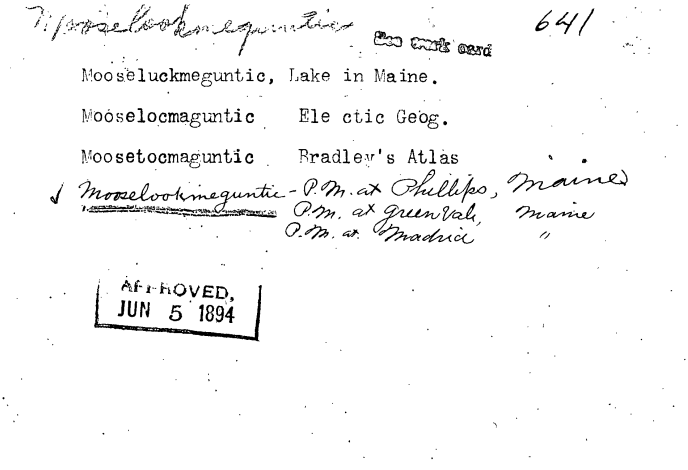
Searching the database can also show you he history of a geographic name officially and unofficially. For example, view this document about all the previous iterations of the Gulf of America, more commonly known as the Gulf of Mexico.
The most recent addition was in 2024. The history details that "This Order implements President Trump's direction in Executive Order 14172, 'Restoring Names That Honor American Greatness,' that the name be changed."

Now You Know Why Apostrophes in Place Names Are Usually Missing
Hopefully this lesson has helped you understand why grammar rules don't always match up with the names of geographic locations. Follow my blog if you want to learn more interesting yet random facts.
Comments